

10 Things Kids with ADHD Wish You Understood
🏠Parent
ADHD Bundle
9 cases · $35 CAD $48
- ADHD: Can’t Get Started
- Too Excited Before a Big Day
- Meltdowns When You Say “No”
- Homework Battles
- Chores Without Nagging
- Runs Off in Stores
- Screen Time Meltdowns
- Why Does My Child Keep Spinning?
One payment. Instant download.
🍎Teacher
ADHD Bundle
8 cases · $35 CAD $48
- ADHD: Can’t Get Started
- Talking to Parents About an ADHD Assessment
- Meltdowns When You Say “No”
- A Student Who Keeps Moving in Class
- A Student Who Avoids Desk Work
- A Student Who Keeps Interrupting
- Settling Down After Recess
- Why Does My Child Keep Spinning?
One payment. Instant download.
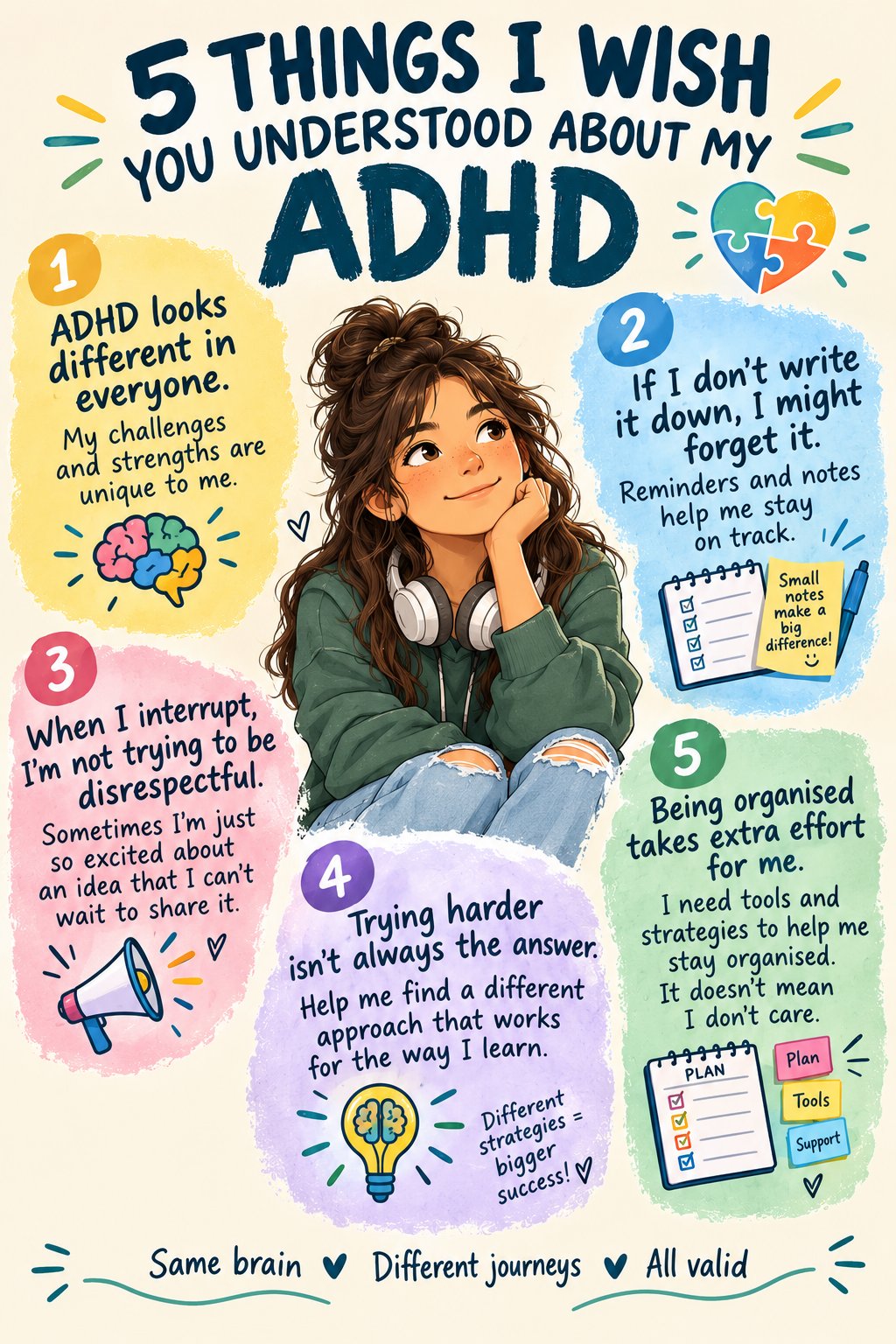
1ADHD looks different in everyone.
My challenges and strengths are unique to me.
Try this
- Write down 3 things your child finds hard and 3 things they’re great at. Plan around both lists, not just the hard one.
- Ask them: “What helps you most?” Kids often know what works for them, and asking builds trust.
2If I don’t write it down, I might forget it.
Reminders and notes help me stay on track.
Try this
- Put steps where they happen: a picture checklist by the door, a sticky note on the homework folder.
- Give one direction at a time, then ask them to say it back to you in their own words.
3When I interrupt, I’m not trying to be disrespectful.
Sometimes I’m just so excited about an idea that I can’t wait to share it.
Try this
- Teach a “hold that thought” signal, like a hand on your arm, and answer it as soon as you can.
- Keep a “wonder notebook” or sticky notes nearby so they can catch the idea and share it later.
4Trying harder isn’t always the answer.
Help me find a different approach that works for the way I learn.
Try this
- Change how the work is done, not how hard they push: say it out loud, draw it, use a whiteboard, or stand up.
- Shorten it: “Do the first 3 questions, then we’ll check in.”
5Being organised takes extra effort for me.
I need tools and strategies to help me stay organised. It doesn’t mean I don’t care.
Try this
- Give everything a home: one bin for school things, one hook for the backpack, a colour for each subject.
- Do a 5-minute “reset” together at the same time every day, and keep it short.
6Starting is the hardest part.
A big task can feel like a wall. Help me break it into small steps and take the first one with me.
Try this
- Name only the first tiny step: “Open your book to page 12.” Stay close until they begin.
- Use a short timer: “Let’s work for 5 minutes, then take a break.”
7Sometimes I can focus for hours, and sometimes I can’t focus for five minutes.
I don’t get to choose when my focus switches on. It isn’t about how much I care.
Try this
- When they’re deep in something, give a warning before switching: “2 more minutes, then dinner.”
- Do the hard tasks when focus is usually best for them, often after a snack and some movement.
8Time is hard for me to feel.
“Five more minutes” and “an hour” can feel the same to me.
Try this
- Use a visual timer they can see counting down, not just a clock.
- Count time in things they know: “That’s as long as one episode.”
9My feelings can get big, really fast.
Give me a quiet moment to calm down first. Then we can talk about what happened.
Try this
- In the big moment, say less. Stay calm, close, and quiet: “I’m right here.”
- Talk about what happened later, once everyone is calm, and plan what to try next time.
10Moving helps me think.
Fidgeting, tapping or standing up isn’t me ignoring you. It helps my brain pay attention.
Try this
- Offer a fidget, a wobble cushion, or the choice to stand while working.
- Build in movement breaks before focus time: jumping jacks, carrying books, a quick walk.
And please, notice what I’m doing right. When you notice my effort, it helps me keep going.
Same brain. Different journeys. All valid.
🎁 Get 3 FREE Cases
Real cases with step-by-step strategies, plus Visual Maps and Blueprints.
Send me the free cases🏠 All-Access Pass - Parent
All 37 parent cases + MY TOOLKIT app + Newsletter. One payment. No subscription.
See the All-Access PassesThese anonymized cases describe generalized patterns of behaviours. They’re not a substitute for an individualised behaviour assessment by a qualified professional, and shouldn’t be applied directly to a specific child without that judgement.